

Beefing Up Broadway: Development Downtown
By Berit Mason
Urban renewal takes off
uptown and downtown
Jones Avenue, off of Broadway, was a lonesome sandy-colored road fifteen years ago, home to the San Antonio Museum of Art—and not much else. Today, the art museum is practically hidden. The trees are grown, and new apartment buildings and pubs crowd the street. River North is among San Antonio’s newly flourishing neighborhoods, urban renewal happening uptown and downtown.
Our city’s first mayor, John William Smith, 1792 - 1845, would flip, seeing his city’s transformation.
“The city is expanding fastest at the edges, typically in areas more than ten miles from the historic core,” says Ian Caine, Associate Professor and Director at the UTSA Center for Urban and Regional Planning Research.
"Most development actually happens at the suburban periphery and in higher-income neighborhoods—and here in San Antonio, that often means the northern suburbs.”
The northern suburbs include Pearl Brewery District, Lower Broadway, and Tobin Hill, hotspots of high-end residential and retail. On Lower Broadway, the construction’s cleared out, and now it’s a spiffy promenade, with clean walkable sidewalks, trendy boutiques and coffee shops, lofts, and strolling yuppies and pups.
The few remaining older abodes on Newell Avenue stand in stark contrast to the cookie cutter developments marching west to San Antonio College neighborhoods.
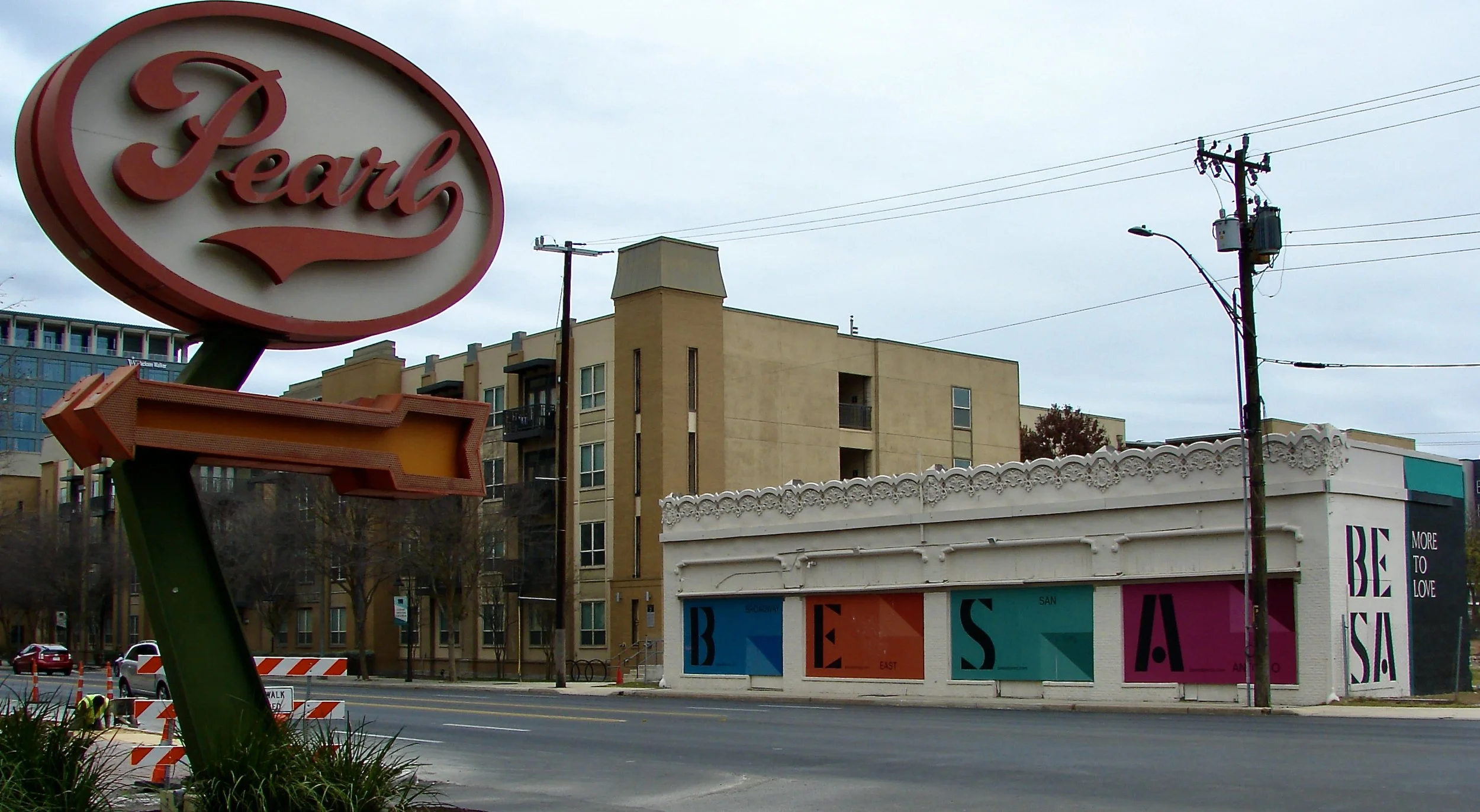
“The latest development [being built] across from the Pearl on Broadway, they’re saving an old facade … so compared to other cities, we are a bit more considerate,” says Dr. Vincent Michael, Executive Director of the San Antonio Conservation Society, its mission to protect historical architecture.
He’s referring to BESA, Broadway East San Antonio, a shopping development coming to the heart of San Antonio in 2027 spanning fifteen acres and four blocks of “a great balance of food offerings and contemporary to luxury fashion.”
Meanwhile, downtown is poised to undergo one of the biggest transformations: the creation of a multi-billion dollar sports and entertainment district, Project Marvel.
Most agree that Hemisfair 1968 was San Antonio’s last great transformation.
“Hemisfair ’68 is probably San Antonio’s best-known example of a redevelopment process known as ‘urban renewal’,” says UTSA’s Caine.
“While it aimed to revitalize, it frequently meant wiping out entire neighborhoods—often in Latino and African American areas—to make way for large-scale civic projects.”
“It is a very audacious and ambitious project,” says Centro San Antonio’s CEO Trish DeBerry. “You’re talking about moving the Spurs arena downtown … and a secondary convention center hotel, near St. Paul’s Square. It is probably a ten-year project, the first phase of which would be moving the Spurs arena.”
Valuation per acre for the San Antonio River Walk. The purple "towers" represent the value per acre of downtown San Antonio. The taller the tower, the more expensive the property. (courtesy Urban3)
The San Antonio Conservation Society fought to stop the razing of the Texas Pavilion, home of the UTSA Institute of Texan Cultures. But its demolition was greenlit in December, to make way for the new Spurs stadium.
“What I love about Project Marvel is as a sports and entertainment district, if you were to have the Spurs arena on the near Eastside, with a land bridge, then you have baseball on the near Westside, you are ‘book-ending’ downtown with sports venues,” says DeBerry. “What I love most about the project is that we’re leaning into what I think made us really great: hospitality.”
With tourism and hospitality as San Antonio’s special draw, the proposed stadiums are to be joined by new bars and restaurants. “Downtown is the core of the hospitality industry with sales tax and the river, and [considering] what downtown earns, it is good for the entire city,” she says.
Joe Minicozzi, founder of Urban3, a consultancy firm specializing in land value economics, property and retail tax analysis, and community design explains downtown San Antonio is worth $4.6 billion, a substantial portion of Bexar County’s wealth. “Cities live off of their downtowns. It’s the walkability and vitality [of cities] that produce wealth for your community.” Urban3 was among presenters and panelists at February’s Impact SA event, hosted by greater:SATX, Centro San Antonio, and Visit San Antonio, with business leaders and local press discussing San Antonio’s bright future.
“Last October, San Antonio was named US City of the Year, and Best Food City, at the UK’s JRNY America Awards. And just last month, the UK Sunday Times named San Antonio as the premier Texas travel destination in the United States for 2025, the only Texas city listed,” said Visit San Antonio President and CEO, Marc Anderson. A gigantic new San Antonio International Airport terminal and 17 new gates are also on the way to welcome all these guests.
Indeed, 150,000 tourism and hospitality workers make up the cornerstone of San Antonio’s prosperity, with more hospitality jobs coming next year when Hemisfair’s Monarch Hotel opens. A booming downtown, however, is only possible if those in the service industry can actually afford to live near their workplaces. Maureen Galindo, a candidate for District 1 councilmember, spoke out against Urban3’s projected land values map, arguing to dispel the myth that the “superficial increase” in land values from downtown developments trickle outward to the rest of San Antonio. “That is straight up government-subsidized land value inflation, which increases all of our costs of living.”
“150,000 tourism and hospitality workers make up the cornerstone of San Antonio’s prosperity”
Many San Antonio residents are skeptical of Project Marvel, voicing dismay at a hefty price tag estimated to be from $2 billion to $4 billion for new sports arenas. One Facebook commenter recalled the run up to building the Alamodome and then the Frost Bank (formerly AT&T) Center—calling Project Marvel “the exact same con.” Others lamented that the city prioritized tourists over its own residents by failing to finish languishing construction projects that cause traffic congestion and hurt small businesses. A few noted the human cost of the development: displacing residents at the Soap Factory and Robert E. Lee apartment complexes, which represent the last affordable housing in the downtown area.
COPS/Metro Alliance, a long-time activist group, chastises Project Marvel, arguing any use of our public monies on it ought to be spent on education and infrastructure. And they have a point, as our long neglected roads are an infrastructure nightmare. A 2027 bond election may bring relief.
Two newcomers from California and Hawaii have opened businesses downtown, to join this renaissance.
“It was a book ‘desert,’ there were no bookstores,” says Barbara Thomas, owner of Pandora’s Bookstore and Coffee House. “But because of the tourist industry and the convention industry, it’s very helpful to be in this location.”
Illustrative rendering of San Antonio Sports and Entertainment District, courtesy City of San Antonio
Pure Aloha Bath and Beauty’s Mariam Bah adds, “We’ve seen a difference where people that don’t often come to downtown are pleased to see we’re here. Now that Broadway construction is over, at least in our section, the street is pretty easy to navigate.”
Having to park downtown has been a reason to avoid it. But Lower Broadway now has free two-hour street parking up and down, and reserving a downtown parking spot may soon be like reserving a table at a restaurant.
"The City requires developers to complete a traffic impact analysis for each project, and implement ‘traffic calming measures,’ if an analysis shows significant impacts,” states the city’s Development Services Department overseeing this great growth and the developers involved in it.
Motorists have been getting all turned around, navigating detours and ripped up roads, like at Market Square. What’s going on here is the Zona Cultural 2017 Bond Project.
“The City’s vision for the project is to strengthen the Zona Cultural District multi-cultural identity, history and community,” encompassing Commerce, Santa Rosa and San Saba.
“We continue to focus on the architectural, natural and cultural heritage of San Antonio,” says the Conservation Society’s Dr. Michael. “We led a successful effort to save the Woolworth building on Alamo Plaza, to make it part of the new Alamo Museum, rather than tear it down.” The new Alamo Visitor Center and Museum also opens in 2027. This city can’t catch a break—there’s so much development going on!
Notifications of Project Marvel funding comes around May, with a likely November 2025 referendum. Thirteen “growth areas” are identified in town—with downtown poised to grow most.
That projection aligns with the years-long vision of civic leaders: to create a thriving urban core; land bridges making it walkable; EV “micro-mobility”; trees, trees and more trees; and housing for a lively downtown, as it was 100 years ago.
As San Antonio is “the fastest growing city” in America, it’s not a question of the amount of growth, but of how it will grow. ■